Status: Draft Type: Standards Track Category: Core Created: 2026-01-18 Requires: CIP-20

Abstract

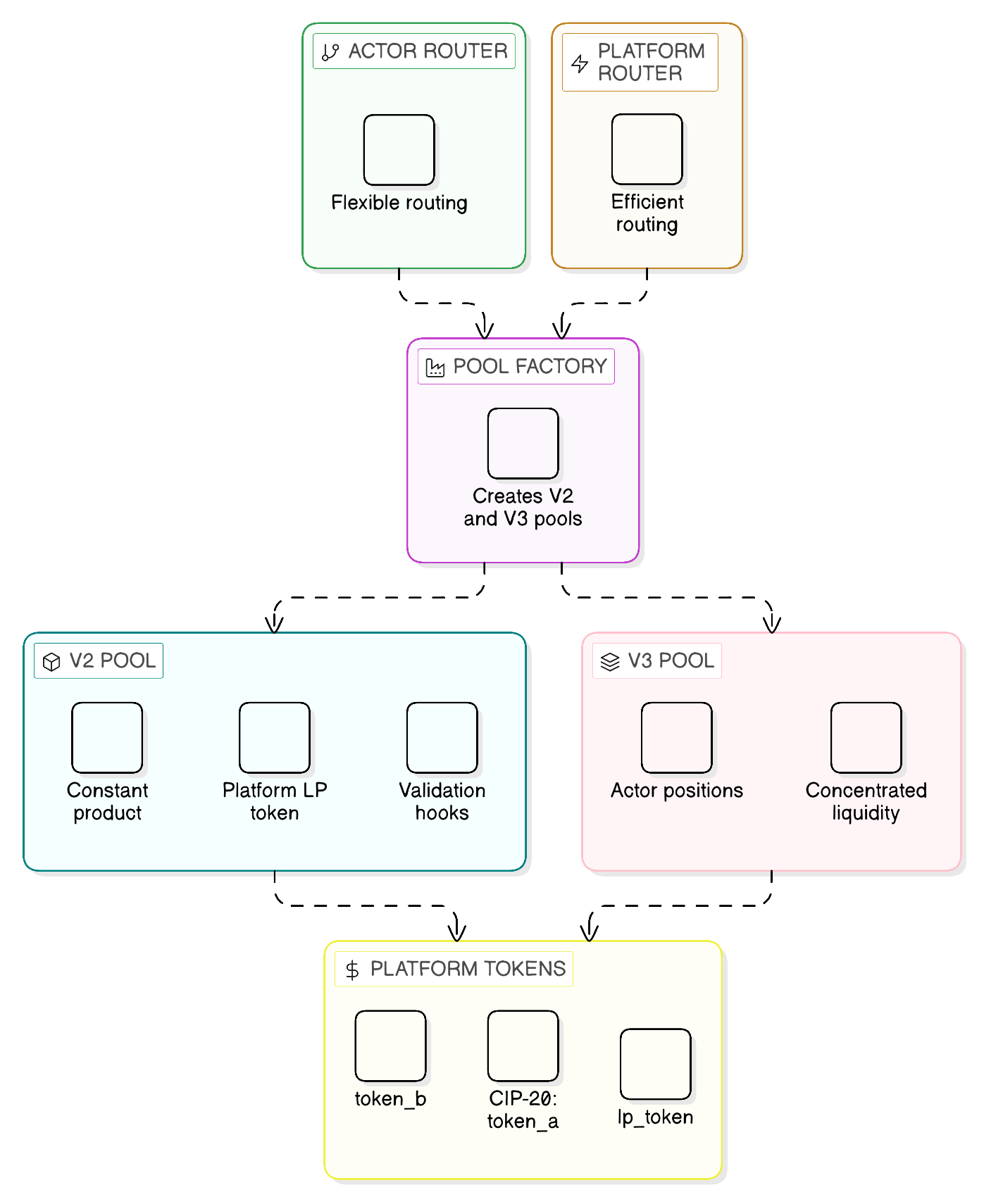
CIP-21 defines Cowboy’s standard for decentralized exchanges and liquidity pools. The design is hybrid: pools are actors (maximum flexibility) with platform-level primitives for efficiency (math helpers, routing, LP tokens). Key features:
  • Two pool types: Constant product (V2-style) and concentrated liquidity (V3-style)
  • Platform LP tokens: Fungible LP shares for V2 pools (CIP-20 tokens)
  • Actor-managed positions: Non-fungible liquidity positions for V3 pools
  • Validation hooks: can_swap / on_swap for compliance and MEV protection
  • Dual routing: Actor-based router for flexibility, platform primitive for efficient multi-hop

Motivation

DEXes are critical infrastructure for any blockchain ecosystem. Cowboy’s unique features—actors, timers, platform tokens—enable DEX designs not possible on Ethereum:
  • Native TWAP oracles via timers (no external keeper)
  • On-chain limit orders via state-triggered timers
  • Efficient batch swaps via platform routing
  • Compliance pools via validation hooks
This CIP provides a standard interface so wallets, aggregators, and applications can interact with any Cowboy DEX predictably.

Specification

Overview

DEX Architecture

Part 1: Platform Primitives

The runtime provides efficient helpers for common AMM operations.

1.1 Math Primitives

# Constant product math
def amm_get_amount_out(
    amount_in: u256,
    reserve_in: u256,
    reserve_out: u256,
    fee_bps: u16
) -> u256:
    """
    Calculate output amount for constant product swap.

    Formula: amount_out = (amount_in * (10000 - fee_bps) * reserve_out)
                         / (reserve_in * 10000 + amount_in * (10000 - fee_bps))

    Cost: 100 Cycles
    """

def amm_get_amount_in(
    amount_out: u256,
    reserve_in: u256,
    reserve_out: u256,
    fee_bps: u16
) -> u256:
    """
    Calculate required input for desired output.

    Cost: 100 Cycles
    """

def amm_quote(
    amount_a: u256,
    reserve_a: u256,
    reserve_b: u256
) -> u256:
    """
    Calculate equivalent amount of token B for given amount of token A.
    Used for adding liquidity at current ratio.

    Cost: 50 Cycles
    """

1.2 Concentrated Liquidity Math

# Tick math (V3-style)
def amm_tick_to_sqrt_price(tick: i24) -> u160:
    """
    Convert tick index to sqrt(price) in Q64.96 format.

    Formula: sqrt_price = 1.0001^(tick/2) * 2^96

    Cost: 200 Cycles
    """

def amm_sqrt_price_to_tick(sqrt_price: u160) -> i24:
    """
    Convert sqrt(price) to nearest tick index.

    Cost: 200 Cycles
    """

def amm_get_liquidity_for_amounts(
    sqrt_price_current: u160,
    sqrt_price_lower: u160,
    sqrt_price_upper: u160,
    amount_a: u256,
    amount_b: u256
) -> u128:
    """
    Calculate liquidity value for given token amounts in a price range.

    Cost: 300 Cycles
    """

def amm_get_amounts_for_liquidity(
    sqrt_price_current: u160,
    sqrt_price_lower: u160,
    sqrt_price_upper: u160,
    liquidity: u128
) -> (u256, u256):
    """
    Calculate token amounts for given liquidity in a price range.

    Cost: 300 Cycles
    """

1.3 Platform Routing

def amm_swap_exact_in(
    path: list[tuple[address, bytes32]],  # [(pool, token_out), ...]
    token_in: bytes32,
    amount_in: u256,
    min_amount_out: u256,
    recipient: address
) -> u256:
    """
    Execute multi-hop swap with exact input amount.

    Path format: [(pool_1, token_mid), (pool_2, token_out)]

    Flow:
    1. Transfer token_in from caller to first pool
    2. For each hop: call pool.swap(), forward output to next pool
    3. Transfer final output to recipient
    4. Verify output >= min_amount_out

    Cost: 1000 + (500 * num_hops) Cycles

    Note: Pools must implement ISwappable interface.
    """

def amm_swap_exact_out(
    path: list[tuple[address, bytes32]],
    token_in: bytes32,
    max_amount_in: u256,
    amount_out: u256,
    recipient: address
) -> u256:
    """
    Execute multi-hop swap with exact output amount.

    Returns: actual amount_in used

    Cost: 1000 + (500 * num_hops) Cycles
    """

Part 2: V2 Pool Standard (Constant Product)

V2 pools use the classic x * y = k formula with fungible LP tokens.

2.1 Interface

class IV2Pool:
    """Standard interface for constant product pools"""

    # Immutable properties
    def token_a(self) -> bytes32: ...
    def token_b(self) -> bytes32: ...
    def lp_token(self) -> bytes32: ...  # Platform token ID
    def fee_bps(self) -> u16: ...        # Fee in basis points (e.g., 30 = 0.30%)

    # State queries
    def get_reserves(self) -> (u256, u256): ...
    def get_spot_price(self, token: bytes32) -> u256: ...  # Price in Q128 format

    # Core operations
    def swap(
        self,
        token_in: bytes32,
        amount_in: u256,
        min_amount_out: u256,
        recipient: address
    ) -> u256: ...

    def add_liquidity(
        self,
        amount_a_desired: u256,
        amount_b_desired: u256,
        amount_a_min: u256,
        amount_b_min: u256,
        recipient: address
    ) -> (u256, u256, u256): ...  # (amount_a, amount_b, lp_minted)

    def remove_liquidity(
        self,
        lp_amount: u256,
        amount_a_min: u256,
        amount_b_min: u256,
        recipient: address
    ) -> (u256, u256): ...  # (amount_a, amount_b)

    # For platform router
    def swap_callback(
        self,
        token_in: bytes32,
        amount_in: u256,
        data: bytes
    ) -> u256: ...

2.2 Validation Hooks

V2 pools MAY specify a validation hook for compliance or MEV protection:
class IV2PoolHook:
    """Validation hook interface for V2 pools"""

    def can_swap(
        self,
        pool: address,
        user: address,
        token_in: bytes32,
        amount_in: u256,
        min_amount_out: u256
    ) -> bool:
        """
        Called before swap execution.

        Return True to allow, False to block.
        Cannot modify amounts.
        """

    def on_swap(
        self,
        pool: address,
        user: address,
        token_in: bytes32,
        amount_in: u256,
        amount_out: u256
    ) -> None:
        """
        Called after successful swap.

        Use for: analytics, fee distribution, MEV rebates.
        Must not revert.
        """

    def can_add_liquidity(
        self,
        pool: address,
        user: address,
        amount_a: u256,
        amount_b: u256
    ) -> bool:
        """Called before adding liquidity."""

    def can_remove_liquidity(
        self,
        pool: address,
        user: address,
        lp_amount: u256
    ) -> bool:
        """Called before removing liquidity."""

2.3 Reference Implementation

class V2Pool(Actor):
    """Constant product AMM with platform LP token"""

    def init(
        self,
        token_a: bytes32,
        token_b: bytes32,
        fee_bps: u16,
        hook: address | None = None
    ):
        require(token_a != token_b, "identical tokens")

        # Sort tokens for canonical ordering
        if token_a > token_b:
            token_a, token_b = token_b, token_a

        self.token_a = token_a
        self.token_b = token_b
        self.fee_bps = fee_bps
        self.hook = hook

        self.reserve_a = 0
        self.reserve_b = 0

        # Create platform LP token
        self.lp_token = Token.create(
            name=f"Cowswap V2 LP",
            symbol="COW-V2-LP",
            decimals=18,
            initial_supply=0
        )

        # TWAP oracle (updated via timer)
        self.price_cumulative_a = 0
        self.price_cumulative_b = 0
        self.last_block = block.height

        # Schedule TWAP updates
        self.schedule_timer(interval=1, handler="update_oracle")

    def swap(
        self,
        token_in: bytes32,
        amount_in: u256,
        min_amount_out: u256,
        recipient: address
    ) -> u256:
        require(token_in in (self.token_a, self.token_b), "invalid token")
        require(amount_in > 0, "zero input")

        # Hook check
        if self.hook:
            allowed = Hook(self.hook).can_swap(
                self.address, msg.sender, token_in, amount_in, min_amount_out
            )
            require(allowed, "swap blocked by hook")

        # Determine direction
        is_a_to_b = token_in == self.token_a
        reserve_in = self.reserve_a if is_a_to_b else self.reserve_b
        reserve_out = self.reserve_b if is_a_to_b else self.reserve_a

        # Calculate output using platform primitive
        amount_out = amm_get_amount_out(amount_in, reserve_in, reserve_out, self.fee_bps)
        require(amount_out >= min_amount_out, "slippage")

        # Transfer tokens
        Token.transfer_from(token_in, msg.sender, self.address, amount_in)
        token_out = self.token_b if is_a_to_b else self.token_a
        Token.transfer(token_out, recipient, amount_out)

        # Update reserves
        if is_a_to_b:
            self.reserve_a += amount_in
            self.reserve_b -= amount_out
        else:
            self.reserve_b += amount_in
            self.reserve_a -= amount_out

        # Hook notification
        if self.hook:
            Hook(self.hook).on_swap(
                self.address, msg.sender, token_in, amount_in, amount_out
            )

        emit_event("Swap", {
            "sender": msg.sender,
            "token_in": token_in,
            "amount_in": amount_in,
            "amount_out": amount_out,
            "recipient": recipient
        })

        return amount_out

    def add_liquidity(
        self,
        amount_a_desired: u256,
        amount_b_desired: u256,
        amount_a_min: u256,
        amount_b_min: u256,
        recipient: address
    ) -> (u256, u256, u256):
        # Hook check
        if self.hook:
            allowed = Hook(self.hook).can_add_liquidity(
                self.address, msg.sender, amount_a_desired, amount_b_desired
            )
            require(allowed, "add liquidity blocked by hook")

        # Calculate optimal amounts
        if self.reserve_a == 0 and self.reserve_b == 0:
            # First deposit sets the ratio
            amount_a = amount_a_desired
            amount_b = amount_b_desired
        else:
            # Match current ratio
            amount_b_optimal = amm_quote(amount_a_desired, self.reserve_a, self.reserve_b)
            if amount_b_optimal <= amount_b_desired:
                require(amount_b_optimal >= amount_b_min, "slippage B")
                amount_a = amount_a_desired
                amount_b = amount_b_optimal
            else:
                amount_a_optimal = amm_quote(amount_b_desired, self.reserve_b, self.reserve_a)
                require(amount_a_optimal <= amount_a_desired, "slippage A")
                require(amount_a_optimal >= amount_a_min, "slippage A")
                amount_a = amount_a_optimal
                amount_b = amount_b_desired

        # Transfer tokens
        Token.transfer_from(self.token_a, msg.sender, self.address, amount_a)
        Token.transfer_from(self.token_b, msg.sender, self.address, amount_b)

        # Mint LP tokens
        total_supply = Token.total_supply(self.lp_token)
        if total_supply == 0:
            lp_amount = sqrt(amount_a * amount_b) - 1000  # Minimum liquidity lock
            Token.mint(self.lp_token, address(0), 1000)   # Lock minimum
        else:
            lp_amount = min(
                amount_a * total_supply / self.reserve_a,
                amount_b * total_supply / self.reserve_b
            )

        require(lp_amount > 0, "insufficient liquidity minted")
        Token.mint(self.lp_token, recipient, lp_amount)

        # Update reserves
        self.reserve_a += amount_a
        self.reserve_b += amount_b

        emit_event("AddLiquidity", {
            "sender": msg.sender,
            "amount_a": amount_a,
            "amount_b": amount_b,
            "lp_minted": lp_amount,
            "recipient": recipient
        })

        return (amount_a, amount_b, lp_amount)

    def remove_liquidity(
        self,
        lp_amount: u256,
        amount_a_min: u256,
        amount_b_min: u256,
        recipient: address
    ) -> (u256, u256):
        # Hook check
        if self.hook:
            allowed = Hook(self.hook).can_remove_liquidity(
                self.address, msg.sender, lp_amount
            )
            require(allowed, "remove liquidity blocked by hook")

        total_supply = Token.total_supply(self.lp_token)

        # Calculate token amounts
        amount_a = lp_amount * self.reserve_a / total_supply
        amount_b = lp_amount * self.reserve_b / total_supply

        require(amount_a >= amount_a_min, "slippage A")
        require(amount_b >= amount_b_min, "slippage B")

        # Burn LP tokens
        Token.transfer_from(self.lp_token, msg.sender, self.address, lp_amount)
        Token.burn(self.lp_token, lp_amount)

        # Transfer tokens
        Token.transfer(self.token_a, recipient, amount_a)
        Token.transfer(self.token_b, recipient, amount_b)

        # Update reserves
        self.reserve_a -= amount_a
        self.reserve_b -= amount_b

        emit_event("RemoveLiquidity", {
            "sender": msg.sender,
            "lp_burned": lp_amount,
            "amount_a": amount_a,
            "amount_b": amount_b,
            "recipient": recipient
        })

        return (amount_a, amount_b)

    def update_oracle(self):
        """Timer callback: update TWAP oracle"""
        blocks_elapsed = block.height - self.last_block
        if blocks_elapsed > 0 and self.reserve_a > 0 and self.reserve_b > 0:
            # Accumulate price * time
            self.price_cumulative_a += (self.reserve_b << 128) / self.reserve_a * blocks_elapsed
            self.price_cumulative_b += (self.reserve_a << 128) / self.reserve_b * blocks_elapsed
            self.last_block = block.height

    def get_twap(self, token: bytes32, period_blocks: u64) -> u256:
        """Get time-weighted average price over period"""
        # Implementation uses price_cumulative snapshots
        ...

2.4 Worked Example: CIP-20 token ↔ V2 pool

This walks the full path end to end — deploy CIP-20 tokens → seed a V2 pool → swap → harvest LP fees — with concrete addresses, amounts, and expected balances. Every figure below is produced by the spec formulas in §1.1 and §2.3 (integer floor division); a runnable snippet that reproduces them is at the end. Cast (illustrative addresses):
RoleAddressHolds
ACME token (CIP-20)0xace0…0020created in step 1
USDC token (CIP-20)0x05dc…0020created in step 1
V2 pool (Medium, 30 bps)0x9001…0021
LP token0x1b71…0021minted by pool
Alice (liquidity provider)0xa11ce…01seeds the pool
Bob (trader)0xb0b…02swaps ACME → USDC
Carol (trader)0xca401…03swaps USDC → ACME (round trip)

Step 1 — Deploy two CIP-20 tokens

# cowboy_sdk — see CIP-20 §"SDK Usage"
acme = Token.create(name="ACME", symbol="ACME", decimals=0, initial_supply=1_000_000)  # -> 0xace0…0020
usdc = Token.create(name="USD Coin", symbol="USDC", decimals=0, initial_supply=1_000_000)  # -> 0x05dc…0020
decimals=0 keeps the arithmetic whole-numbered for readability; production tokens typically use 6–18 decimals.

Step 2 — Seed the V2 pool (first liquidity)

The pool pulls both legs with Token.transfer_from (Alice must approve the pool first), then mints LP tokens. For the first provider the spec mints sqrt(amount_a * amount_b) - 1000 and locks 1000 to address(0):
Token.approve(acme, pool, 100_000)
Token.approve(usdc, pool, 100_000)
pool.add_liquidity(amount_a_desired=100_000, amount_b_desired=100_000,
                   amount_a_min=100_000, amount_b_min=100_000, recipient=alice)
# lp = sqrt(100_000 * 100_000) - 1000 = 100_000 - 1000 = 99_000
ACME reserveUSDC reservek = a·bLP supplyAlice LP
after seed100_000100_00010_000_000_000100_00099_000
Emits AddLiquidity(alice, 100_000, 100_000, 99_000, alice) and Sync(100_000, 100_000). 1_000 LP is permanently locked at address(0) (anti-first-depositor-griefing), so Alice owns 99_000 / 100_000 = 99% of the pool.

Step 3 — Swap (round trip)

Bob swaps 10_000 ACME for USDC. With fee_bps = 30:
amount_out = (10_000 * (10000-30) * 100_000) / (100_000 * 10000 + 10_000 * (10000-30))
           = (10_000 * 9970 * 100_000) / (1_000_000_000 + 99_700_000)
           = 9_970_000_000_000 / 1_099_700_000
           = 9_066   (USDC, floored)
Carol then swaps those 9_066 USDC back for ACME, returning the price to ~1:1 so the harvest in step 4 is purely accrued fees (no impermanent-loss noise):
SwapInOutACME reserveUSDC reservek = a·b
Bob: ACME→USDC10_000 ACME9_066 USDC110_00090_93410_002_740_000
Carol: USDC→ACME9_066 USDC9_945 ACME100_055100_00010_005_500_000
Each swap emits Swap(sender, token_in, amount_in, amount_out, recipient) and a Sync. Note k strictly grows (10.000B → 10.0055B): the 30 bps fee on every swap stays in the reserves. That growth is the LP fee.

Step 4 — Harvest LP fees

V2 has no separate “claim fees” call — fees accrue into the reserves, so each LP token becomes redeemable for more than it was at seed. Measuring redemption value per LP token isolates the fee cleanly (it is unaffected by the locked 1_000):
Pool value (ACME + USDC)LP supplyValue per LP
at seed200_000100_0002.00000
after round trip200_055100_0002.00055
+0.0275% per LP token — entirely harvested swap fees. Alice realizes her share by burning her LP:
pool.remove_liquidity(lp_amount=99_000, amount_a_min=0, amount_b_min=0, recipient=alice)
# amount_a = 99_000 * 100_055 / 100_000 = 99_054 ACME
# amount_b = 99_000 * 100_000 / 100_000 = 99_000 USDC
Alice receives 99_054 ACME + 99_000 USDC (emits RemoveLiquidity(alice, 99_000, 99_054, 99_000, alice)). Her LP redeemed at the grown per-LP value (2.00055 vs 2.00000 at seed): that uplift is her cut of the 30 bps fees Bob and Carol paid. (Her redemption tracks 99% of reserves, not 100%, because of the locked minimum liquidity.)

Reproduce the numbers

import math

def amount_out(amount_in, reserve_in, reserve_out, fee_bps=30):
    return (amount_in * (10000 - fee_bps) * reserve_out) \
        // (reserve_in * 10000 + amount_in * (10000 - fee_bps))

ra, rb = 100_000, 100_000                       # seed reserves (ACME, USDC)
lp = math.isqrt(ra * rb) - 1000                 # 99_000 to Alice
ts = lp + 1000                                  # 100_000 incl. locked minimum
o1 = amount_out(10_000, ra, rb); ra += 10_000; rb -= o1   # Bob:  -> 9_066 USDC
o2 = amount_out(o1, rb, ra);     rb += o1;     ra -= o2    # Carol:-> 9_945 ACME
print(ra, rb, ra * rb)                          # 100055 100000 10005500000
print(lp * ra // ts, lp * rb // ts)             # 99054 99000  (Alice's harvest)

Part 3: V3 Pool Standard (Concentrated Liquidity)

V3 pools allow LPs to concentrate liquidity in price ranges for higher capital efficiency.

3.1 Core Concepts

Ticks: Price space is divided into discrete ticks. Each tick represents a 0.01% price change. Positions: LPs provide liquidity between two ticks (a price range). Positions are non-fungible. Liquidity: A position’s liquidity value determines its share of fees when price is in range.

3.2 Interface

class IV3Pool:
    """Standard interface for concentrated liquidity pools"""

    # Immutable properties
    def token_a(self) -> bytes32: ...
    def token_b(self) -> bytes32: ...
    def fee_bps(self) -> u16: ...
    def tick_spacing(self) -> i24: ...

    # State queries
    def slot0(self) -> (u160, i24, u16):  # (sqrt_price, tick, protocol_fee)
        ...
    def liquidity(self) -> u128: ...  # Current active liquidity
    def ticks(self, tick: i24) -> TickInfo: ...
    def positions(self, position_id: bytes32) -> PositionInfo: ...

    # Swap
    def swap(
        self,
        token_in: bytes32,
        amount_in: u256,
        sqrt_price_limit: u160,
        recipient: address
    ) -> (u256, u256): ...  # (amount_in_actual, amount_out)

    # Liquidity management
    def mint_position(
        self,
        tick_lower: i24,
        tick_upper: i24,
        amount: u128,
        recipient: address
    ) -> (bytes32, u256, u256): ...  # (position_id, amount_a, amount_b)

    def burn_position(
        self,
        position_id: bytes32,
        amount: u128  # Portion of position to burn
    ) -> (u256, u256): ...  # (amount_a, amount_b)

    def collect_fees(
        self,
        position_id: bytes32,
        recipient: address
    ) -> (u256, u256): ...  # (fees_a, fees_b)

3.3 Position Data

Positions are stored in actor state (not as NFTs):
@dataclass
class PositionInfo:
    owner: address
    tick_lower: i24
    tick_upper: i24
    liquidity: u128

    # Fee tracking
    fee_growth_inside_a_last: u256
    fee_growth_inside_b_last: u256
    fees_owed_a: u128
    fees_owed_b: u128

@dataclass
class TickInfo:
    liquidity_gross: u128      # Total liquidity referencing this tick
    liquidity_net: i128        # Net liquidity change when crossing
    fee_growth_outside_a: u256
    fee_growth_outside_b: u256
    initialized: bool

3.4 Validation Hooks

V3 pools use the same hook interface as V2:
class IV3PoolHook:
    def can_swap(self, pool, user, token_in, amount_in, sqrt_price_limit) -> bool: ...
    def on_swap(self, pool, user, token_in, amount_in, amount_out) -> None: ...
    def can_mint_position(self, pool, user, tick_lower, tick_upper, amount) -> bool: ...
    def can_burn_position(self, pool, user, position_id, amount) -> bool: ...

3.5 Position Manager (Optional)

For better UX, a position manager actor can wrap positions as transferable:
class V3PositionManager(Actor):
    """Wraps V3 positions for transferability"""

    def mint(
        self,
        pool: address,
        tick_lower: i24,
        tick_upper: i24,
        amount_a_desired: u256,
        amount_b_desired: u256,
        recipient: address
    ) -> u256:  # position_nft_id
        # Mint position in pool, store mapping
        ...

    def transfer_position(self, position_nft_id: u256, to: address):
        # Update owner mapping
        ...

    def increase_liquidity(self, position_nft_id: u256, amount_a: u256, amount_b: u256):
        ...

    def decrease_liquidity(self, position_nft_id: u256, liquidity: u128):
        ...

    def collect(self, position_nft_id: u256, recipient: address):
        ...

Part 4: Factory

The factory creates and indexes pools:
class ICowswapFactory:
    """Factory interface for creating pools"""

    def create_v2_pool(
        self,
        token_a: bytes32,
        token_b: bytes32,
        fee_bps: u16,
        hook: address | None = None
    ) -> address: ...

    def create_v3_pool(
        self,
        token_a: bytes32,
        token_b: bytes32,
        fee_bps: u16,
        tick_spacing: i24,
        hook: address | None = None
    ) -> address: ...

    def get_v2_pool(self, token_a: bytes32, token_b: bytes32, fee_bps: u16) -> address: ...
    def get_v3_pool(self, token_a: bytes32, token_b: bytes32, fee_bps: u16) -> address: ...

    def get_all_pools(self, token_a: bytes32, token_b: bytes32) -> list[address]: ...

Standard Fee Tiers

TierFee (bps)V3 Tick SpacingUse Case
Stable11Stablecoin pairs
Low510Correlated pairs
Medium3060Most pairs
High100200Exotic pairs

Part 5: Router

5.1 Actor Router (Flexible)

class CowswapRouter(Actor):
    """Flexible router with path-finding and complex operations"""

    def swap_exact_in(
        self,
        path: list[tuple[address, bytes32]],  # [(pool, token_out), ...]
        token_in: bytes32,
        amount_in: u256,
        min_amount_out: u256,
        recipient: address,
        deadline: u64
    ) -> u256:
        require(block.timestamp <= deadline, "expired")

        # Execute swaps along path
        current_amount = amount_in
        current_token = token_in

        for (pool, token_out) in path:
            current_amount = Pool(pool).swap(
                current_token,
                current_amount,
                0,  # No slippage check on intermediate
                self.address if not last_hop else recipient
            )
            current_token = token_out

        require(current_amount >= min_amount_out, "slippage")
        return current_amount

    def swap_exact_out(
        self,
        path: list[tuple[address, bytes32]],
        token_in: bytes32,
        max_amount_in: u256,
        amount_out: u256,
        recipient: address,
        deadline: u64
    ) -> u256:
        # Calculate required input, then execute
        ...

    def add_liquidity_v2(self, pool, amount_a, amount_b, min_lp, recipient, deadline):
        ...

    def remove_liquidity_v2(self, pool, lp_amount, min_a, min_b, recipient, deadline):
        ...

    def mint_position_v3(self, pool, tick_lower, tick_upper, amount_a, amount_b, recipient, deadline):
        ...

5.2 Platform Router (Efficient)

The platform router (amm_swap_exact_in / amm_swap_exact_out) provides:
  • Lower gas cost (no actor call overhead per hop)
  • Atomic multi-hop execution
  • Standardized interface
Use platform router when:
  • Standard path-based swap
  • No custom logic needed
  • Maximum efficiency required
Use actor router when:
  • Complex operations (add liquidity + swap)
  • Custom fee handling
  • Flash swaps

Part 6: Advanced Features

6.1 Native TWAP Oracle

V2 pools include a built-in TWAP oracle updated via timers:
# Get 30-minute TWAP
twap_price = pool.get_twap(token_a, period_blocks=300)  # ~5 min at 1s blocks
No external oracle needed. Price manipulation requires sustained capital over the period.

6.2 On-Chain Limit Orders

Using CIP-5 state-triggered timers:
class LimitOrderBook(Actor):
    def place_order(
        self,
        pool: address,
        token_in: bytes32,
        amount_in: u256,
        min_price: u256,  # Trigger price
        expiry: u64
    ) -> u256:  # order_id
        order_id = self._create_order(msg.sender, pool, token_in, amount_in, min_price, expiry)

        # Transfer tokens to escrow
        Token.transfer_from(token_in, msg.sender, self.address, amount_in)

        # Schedule state-triggered timer
        self.schedule_timer(
            trigger_type="state",
            watch_address=pool,
            watch_key="slot0.sqrt_price",
            condition=f">= {min_price}",
            handler="try_fill",
            args={"order_id": order_id}
        )

        return order_id

    def try_fill(self, order_id: u256):
        order = self.orders[order_id]

        # Check price still favorable
        (sqrt_price, _, _) = Pool(order.pool).slot0()
        if sqrt_price >= order.min_price:
            # Execute swap
            amount_out = Pool(order.pool).swap(
                order.token_in,
                order.amount_in,
                0,
                order.owner
            )
            self._close_order(order_id, filled=True)
        # Else: timer will re-trigger on next price change

    def cancel_order(self, order_id: u256):
        order = self.orders[order_id]
        require(msg.sender == order.owner, "not owner")

        Token.transfer(order.token_in, order.owner, order.amount_in)
        self._close_order(order_id, filled=False)

6.3 MEV Protection via Hooks

class MEVProtectionHook(Actor):
    """Pool hook that implements MEV rebates"""

    def can_swap(self, pool, user, token_in, amount_in, min_out) -> bool:
        # Allow all swaps
        return True

    def on_swap(self, pool, user, token_in, amount_in, amount_out):
        # Calculate if user was sandwiched
        expected_out = self._calculate_fair_output(pool, token_in, amount_in)

        if amount_out < expected_out * 0.99:  # >1% worse than fair
            # User was likely sandwiched, log for rebate
            emit_event("MEVDetected", {
                "user": user,
                "expected": expected_out,
                "actual": amount_out,
                "loss": expected_out - amount_out
            })
            # Rebate logic could be added here

6.4 Compliance Pools

class KYCPoolHook(Actor):
    """Pool hook requiring KYC for swaps"""

    def init(self, kyc_registry: address):
        self.kyc_registry = kyc_registry

    def can_swap(self, pool, user, token_in, amount_in, min_out) -> bool:
        # Check KYC status
        return KYCRegistry(self.kyc_registry).is_verified(user)

    def can_add_liquidity(self, pool, user, amount_a, amount_b) -> bool:
        return KYCRegistry(self.kyc_registry).is_verified(user)

    def can_remove_liquidity(self, pool, user, lp_amount) -> bool:
        # Always allow withdrawal (regulatory requirement)
        return True

Events

V2 Pool Events

Swap(sender: address, token_in: bytes32, amount_in: u256, amount_out: u256, recipient: address)
AddLiquidity(sender: address, amount_a: u256, amount_b: u256, lp_minted: u256, recipient: address)
RemoveLiquidity(sender: address, lp_burned: u256, amount_a: u256, amount_b: u256, recipient: address)
Sync(reserve_a: u256, reserve_b: u256)

V3 Pool Events

Swap(sender: address, recipient: address, amount_a: i256, amount_b: i256, sqrt_price: u160, liquidity: u128, tick: i24)
Mint(sender: address, owner: address, tick_lower: i24, tick_upper: i24, amount: u128, amount_a: u256, amount_b: u256)
Burn(owner: address, tick_lower: i24, tick_upper: i24, amount: u128, amount_a: u256, amount_b: u256)
Collect(owner: address, recipient: address, tick_lower: i24, tick_upper: i24, amount_a: u128, amount_b: u128)

Security Considerations

Reentrancy

The actor model provides natural reentrancy protection—actors process one message at a time. However, cross-actor calls during swaps should follow checks-effects-interactions pattern.

Price Manipulation

  • TWAP oracles mitigate flash loan attacks
  • Concentrated liquidity pools are more sensitive to manipulation at range boundaries
  • Hooks can implement additional protections (MEV detection, circuit breakers)

Hook Security

  • Hooks are capped at 50,000 Cycles and 50,000 Cells (same as CIP-20 token hooks)
  • Malicious hooks can block all swaps—pool deployers must be trusted
  • Consider timelock for hook updates on major pools

Integer Precision

  • Use Q128 format for prices to maintain precision
  • Concentrated liquidity math uses Q64.96 (matching Uniswap V3)
  • Platform primitives handle precision; actor implementations should use them

Rationale

Why Hybrid (Actor + Platform)?

Pure actor-based: Maximum flexibility but higher gas costs Pure platform-based: Maximum efficiency but inflexible Hybrid gives:
  • Flexibility for pool logic (actors)
  • Efficiency for common operations (platform primitives)
  • Best of both worlds

Why Both V2 and V3?

V2 (constant product):
  • Simpler for LPs
  • Fungible LP tokens (composable with DeFi)
  • Lower gas cost
  • Good for stable pairs
V3 (concentrated):
  • Higher capital efficiency
  • Better for professional LPs
  • Required for competitive pricing on major pairs

Why Validation-Only Hooks?

Full hooks (modifying amounts) add complexity:
  • Unpredictable outputs
  • Gas estimation difficulty
  • Hidden fees
Validation hooks are simpler:
  • Swap succeeds or fails
  • Predictable gas
  • Covers compliance use cases

Backwards Compatibility

This is a new standard. No backwards compatibility concerns.

Reference Implementation

See cowboy-core/src/runtime/amm.rs for platform primitive implementations. See examples/cowswap/ for reference V2 and V3 pool implementations.