

Introduction
Cowboy is a Layer 1 blockchain designed from the ground up for autonomous agents and verifiable off-chain computation . This document provides a high-level overview of the system architecture.
TL;DR : Cowboy combines a Python-based Actor VM (PVM), dual-metered gas, native timers, verifiable off-chain compute (LLM/HTTP/MCP runners), and encrypted distributed storage (CBFS) into a cohesive protocol for agentic applications.
Note: API names in diagrams and examples reflect the real pvm_host and cowboy_sdk surface. See the SDK Overview and CIP specifications for authoritative behavior.
System Architecture
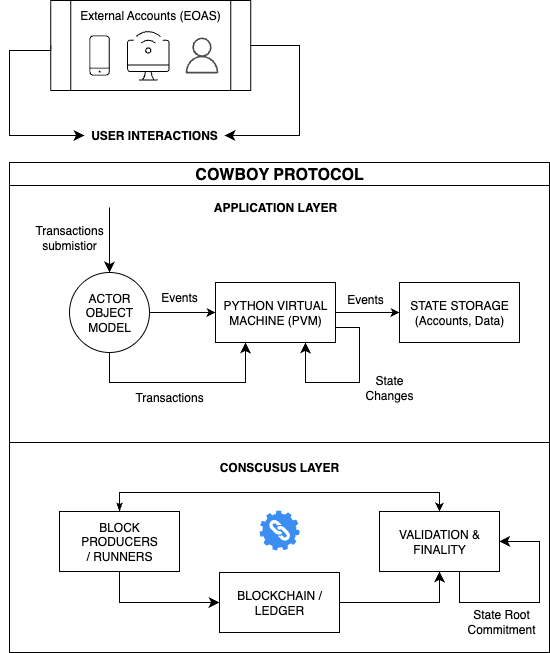
Core Components
1. Actor VM (Python Runtime)
Purpose : Execute actor (smart contract) code deterministically
Key Features :
Python bytecode interpreter (no JIT)
Deterministic execution (no system calls, software FPU)
Dual-metered gas (Cycles for compute, Cells for data)
Sandboxed environment (no I/O, no network)
Architecture :
+------------------------------------------------------------+
| PVM (Rust-based Python VM) |
| |
| +------------------------------------------------------+ |
| | Python Bytecode Interpreter | |
| | - Instruction dispatch | |
| | - Stack management | |
| | - Fuel (cycles) metering | |
| | - Checkpoint / resume | |
| +------------------------------------------------------+ |
| |
| +------------------------------------------------------+ |
| | pvm_host (low-level) / cowboy_sdk | |
| | - get_state / set_state | |
| | - send (async actor-to-actor messages) | |
| | - timer scheduling (CIP-1) | |
| | - runner.llm / runner.http / runner.mcp (CIP-2) | |
| | - CBFS volume attach | |
| +------------------------------------------------------+ |
| |
| +------------------------------------------------------+ |
| | Determinism Layer | |
| | - Software floating-point (SoftFloat) | |
| | - Curated stdlib whitelist | |
| | - No JIT compilation | |
| +------------------------------------------------------+ |
+------------------------------------------------------------+
The CIP-6 SDK (cowboy_sdk) sits on top of pvm_host, providing an @actor decorator, CBOR auto-serialization, and a continuation FSM for async runner calls.
See : Actor VM Overview · SDK Overview
2. Consensus Layer (Simplex BFT)
Purpose : Achieve agreement on block ordering and finality
Key Features :
Byzantine Fault Tolerant (BFT)
Deterministic finality (no reorgs)
Leader-based block proposal
Quorum certificates (QC) for votes
Flow :
Block Proposal Flow:
1. Leader proposes block
2. Validators validate:
|-- Transactions valid?
|-- State transition correct?
\-- Gas limits respected?
3. Validators vote (signature)
4. QC formed (2/3+ votes)
5. Block finalized
6. Next leader elected
Properties :
Safety : No forks (deterministic finality)
Liveness : Progress guaranteed with 2/3+ honest validators
3. Dual-Metered Gas System
Purpose : Fair resource pricing for compute and data
Architecture :
Transaction Execution
|
|-- Compute Operations
| |-- Bytecode execution -> Charged in Cycles
| |-- Function calls -> Charged in Cycles
| \-- Hash computations -> Charged in Cycles
|
\-- Data Operations
|-- Transaction payload -> Charged in Cells
|-- Storage writes -> Charged in Cells
\-- Return data -> Charged in Cells
Independent Fee Markets :
Each resource has its own basefee
Basefees adjust independently (dual EIP-1559)
Prevents cross-subsidization
See : Fee Model
4. Timer Scheduler (CIP-1)
Purpose : Native timer scheduling with autonomous execution
Architecture :
+------------------------------------------------------------+
| Hierarchical Calendar Queue |
| |
| +------------------------------------------------------+ |
| | Layer 1: Block Ring Buffer | |
| | [B+0][B+1][B+2]...[B+255] | |
| | O(1) access for near-term timers | |
| +------------------------------------------------------+ |
| |
| +------------------------------------------------------+ |
| | Layer 2: Epoch Queue | |
| | [E+1][E+2]...[E+N] | |
| | Buckets for mid-term timers | |
| +------------------------------------------------------+ |
| |
| +------------------------------------------------------+ |
| | Layer 3: Overflow Sorted Set | |
| | Merkle BST for long-term timers | |
| +------------------------------------------------------+ |
+------------------------------------------------------------+
|
v
+------------------------------------------------------------+
| Gas Bidding Agents (GBA) |
| - Each actor specifies GBA contract |
| - GBA returns bid based on block context |
| - Priority queue orders by effective bid |
+------------------------------------------------------------+
Execution Flow :
Actor schedules a timer (conceptual API; CIP-1 requires specifying a Gas Bidding Agent)
Timer stored in calendar queue
At trigger block:
Query GBA for bid
Add to priority queue
Execute highest bids first (within budget)
See : Scheduler Overview
5. Off-Chain Compute (CIP-2)
Purpose : Verifiable execution of AI models, API calls, heavy computation
Architecture :
+------------------------------------------------------------+
| On-Chain Components |
| |
| +--------------------+ +--------------------+ |
| | Task Dispatcher | | Runner Registry | |
| | - Submit task | | - Registration | |
| | - Lock payment | | - Active list | |
| | - VRF snapshot | | - Health decay | |
| +--------------------+ +--------------------+ |
| |
| +--------------------+ |
| | Runner Submit | |
| | - Verify select | |
| | - Store result | |
| | - Trigger CB | |
| +--------------------+ |
+------------------------------------------------------------+
| Task & Result submission |
v
+------------------------------------------------------------+
| Off-Chain Runners |
| |
| +------------------------------------------------------+ |
| | Runner Service | |
| | - Monitor TaskSubmitted events | |
| | - Calculate VRF selection | |
| | - Execute: download model, run inference | |
| | - Generate proof (if required) | |
| | - Submit result on-chain | |
| +------------------------------------------------------+ |
+------------------------------------------------------------+
Selection Mechanism (VRF-based):
// Pseudocode (conceptual): VRF Selection = Deterministic + Verifiable + Decentralized
start_index = hash(vrf_seed + (submission_block - vrf_generation_block)) % active_list_size
selected_runners = active_list[start_index : start_index + N] # wrap around (ring buffer)
✅ No central coordinator
✅ Anyone can verify selection
✅ Fair over time
See : Off-Chain Compute
6. Encrypted Distributed Storage (CBFS)
Purpose : Store data too large for on-chain persistence — models, datasets, media, logs — with end-to-end encryption and redundancy.
Architecture :
+------------------------------------------------------------+
| Client (actor or runner) |
| |
| cbfs-fuse (mount) ── cbfs-sdk (Volume API) ── cbfs-auth |
| | | | |
| v v v |
| write-back cache AES-256-GCM encrypt RAS tokens |
| | |
| v |
| Reed-Solomon (K+M) |
| | |
| v |
| QUIC transport |
+------------------------------------------------------------+
|
v
+------------------------------------------------------------+
| Storage Relays |
| cbfs-node daemons × N — Sled blob store, shard serving |
+------------------------------------------------------------+
|
Control plane via Cowboy RPC: volume registry,
manifest authority, delegated capability tokens
Key properties:
Client-side encryption — storage nodes never see plaintext
Reed-Solomon erasure coding — K data + M parity shards, recover from any K
Delegated auth — owner signs short-lived capability tokens; no chain write on every data-plane call
Self-healing — background repair detects dead nodes and re-shards
FUSE mount — volumes appear as normal filesystems to actors and runners
See : CIP-4 State Storage · CIP-9 Runner Storage
Transaction Lifecycle
1. Transaction Submission
|-- User creates transaction
|-- Signs with private key
\-- Broadcasts to network
2. Mempool
|-- Validators receive transaction
|-- Validate signature, nonce, balance
\-- Add to mempool (priority by tip)
3. Block Proposal
|-- Leader selects transactions from mempool
|-- Orders by priority (effective tip)
\-- Proposes block
4. Block Validation
|-- Validators execute transactions
|-- Check state transitions
|-- Verify gas limits
\-- Sign vote (QC)
5. Block Finalization
|-- QC formed (>= 2/3 votes)
|-- Block committed to chain
|-- State root updated
\-- Receipts generated
6. State Update
|-- Actor state persisted
|-- Balances updated
|-- Events emitted
\-- Next nonce incremented
State Organization
Global State (σ)
|-- Accounts
| |-- Balances (address -> amount)
| |-- Nonces (address -> uint64)
| \-- Actor Code (address -> bytecode)
|
|-- Actor State
| \-- Key-Value Storage (actor_address + key -> value)
|
|-- Scheduler State
| |-- Timer queues (hierarchical calendar queue)
| \-- Scheduling indices and metadata
|
|-- Off-Chain State
| |-- Active Runner List
| |-- Pending Tasks
| \-- Task Results
|
\-- Protocol State
|-- Validator Set
|-- Basefees (cycle & cell)
\-- Governance Parameters
State Root : Merkle tree root of entire state
State Transition : σ' = STF(σ, B) where B is block
Network Layer
P2P Network :
Gossip protocol for transaction propagation
Block proposal distribution
Vote (QC) aggregation
State synchronization
Node Types :
Validator : Participates in consensus, proposes/validates blocks
Full Node : Stores full state, serves queries
Light Client : Only block headers, verifies proofs
Runner : Executes off-chain tasks (not part of consensus)
Communication :
Validators <--> P2P Network <--> Full Nodes
↕
Runners (off-chain)
• Monitor events
• Submit results
Storage Layer
Components :
State Storage :
Merkleized key-value store
Key: account/actor address + storage key
Value: serialized data
Root hash in block header
Block Storage :
Sequential blocks
Headers + transactions
Indexed by height and hash
Transaction Log :
All transactions (historical)
Receipts with events
Queryable by hash, block, address
Archive Node (optional):
Full historical state
Every block’s complete state
For queries like “balance at block X”
Security Model
Threat Model :
Byzantine validators (up to 1/3)
Malicious actors (smart contracts)
DoS attacks (computational, storage)
Network attacks (eclipse, Sybil)
Defenses :
Consensus Security :
BFT tolerance (2/3+ honest required)
VM Security :
Sandboxed execution (no I/O)
Resource limits (cycles, cells, memory)
Deterministic execution (no non-determinism)
Gas Economics :
Dual-metered prevents abuse
Basefee burn (anti-spam)
Priority market (fair access)
Off-Chain Security :
VRF-based selection (no coordinator)
Configurable verification requirements (per CIP-2)
Economic incentives (per application design)
Performance metrics, governance processes, and network parameters are implementation-dependent and subject to change. Refer to authoritative releases and CIPs for normative updates when available.
Next Steps
Actor VM Deep Dive How the PVM achieves deterministic Python execution
Fee Model Dual-metered gas and EIP-1559 basefees
Scheduler Native timer system (CIP-1)
Off-Chain Compute Verifiable runner network (CIP-2)
State Storage QMDB state store + Merkle proofs (CIP-4)
SDK Overview The cowboy_sdk Python library (CIP-6)
Further Reading